

Top view of female students learning computer programming. Girls in computer lab coding on laptops.
Fake news, questioning, and …
Fake news, questioning, and happiness proteins
'You are seeing a protein pull an endorphin along a filament to the inner part of the parietal cortex of the brain that generates happiness. You're looking at happiness.' (by Fatos do Universo, Feb 6 2018 on Facebook)
'This is what happiness really looks like: Molecules of the protein myosin drag a ball of endorphins along an active filament into the inner part of the brain's parietal cortex, which produces feelings of happiness.' (by cacula, Dec 10, 2015 on imgur)
Version 1 appears to have had over 30 million views already though that number is likely low since this isn’t the first or only time it’s been posted; the Imgur version totals around 38,000 views. What both demonstrate, however, is how rapidly this little guy has been spread to a wide audience. Without much educational background beyond science-y videos we’re all familiar with (e.g. Life or Planet Earth documentary series), paired with the uplifting descriptions and its cute walk, it can be simple enough to imagine this being true. Even if we may recognise that the description is written for a non-expert audience, most people (304+ million apparently) seem to disregard any little inaccuracies and share it without thinking, attaching additional comments to their shares like 'I want some' or 'it’s definitely strutting like happiness lol'. Perhaps you’re fairly sceptical like me though (EAP could contribute here). Besides my awareness that misinformation is often spread without thinking, a few critical questions entered my mind when this GIF crossed my path:
Are proteins and endorphins actually so colourful?
Where is the light coming from that generate the shadows?
Can scientists get a camera small enough to go inside a brain to see such microorganisms?
What was the patient undergoing that they agreed to have this part of their brain filmed (it couldn’t be simply for a documentary)?
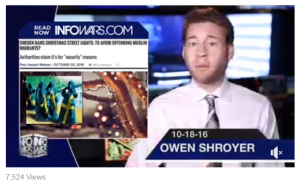
These types of questions cause me to search for more information about the likelihood of it being accurate. What I learned, however, is that in reality, this is a video animation included in a documentary which is not specifically about happiness but more a representation of how any protein 'can play a role in transporting numerous important chemicals within neurons' or something to that effect. While this example may seem fairly innocuous—what real damage is done by spreading this misinformation like this? Does it negatively impact someone’s life? Perhaps not in this example—not all social media shares like this are so ‘happy’. Another video, based on an article from a media site, Infowars.com, has also been shared across social media sites, particularly around the holidays. In this video, the headline states: SWEDEN BANS CHRISTMAS STREET LIGHTS; TO AVOID OFFENDING MUSLIM MIGRANTS?Authorities claim it’s for 'security' reasons. [caption id="attachment_10854" align="alignright" width="300"]
Incorporating critical reading and questioning into the classroom
One way to provide strategies for students involving fake news can involve the two examples of misinformation above. Here is a mini lesson plan idea that aims to raise awareness of information source, critical questioning of information, and strategies to determine truth. 1. On enough pieces of paper for half your students, write 'This was posted on Facebook'. On enough pieces of paper for the other half of your students, write 'This was shared in a university Life Science lecture'. 2. Play the happiness protein GIF for students and give them the accompanying description(s). 3. Pair students together. Give Student A the Facebook information and Student B the Life Science lecture information. Tell students that this is information only they know and they cannot reveal it to their partner. 4. Ask pairs to discuss their reactions to the happiness protein GIF for a few minutes. Gauge their discussions. If needed, provide a few guiding questions at this point:
Do you believe the information in this GIF?
Would you think of any questions about the GIF that you’re curious about?
If you learned that the source of this information was different than you know, would that change your opinion of the information? How?
5. Have students exchange pieces of paper. Ask for their reactions.
Have them discuss which they believe is the truth and why.
Ask them to make a list of questions they have about the information based on their decision. Elicit these questions for everyone and discuss as a class.
Slate’s 'If it happened there' series
Perspecnews for differing angles on one topic
The New York Times on critically evaluating visual media
[caption id="attachment_10855" align="alignright" width="300"]

About the author

Tyson Seburn is Lead EAP instructor of Critical Reading & Writing and Assistant Academic Director of International Programs at New College, University of Toronto. He holds an MA Educational Technology & TESOL from the University of Manchester. His main interest focuses on public spaces for exploring teacher identity and development. These include an EAP discussion group, #tleap (bit.do/tleap); his blog, 4CinELT (fourc.ca); and his work on the IATEFL Teacher Development Special Interest Group committee (tdsig.org). He is the author of Academic Reading Circles (The Round, 2015). References and other materials Chong, C. S. (2017, January 18). How to identify fake news. English Teaching Professional. Available at https://www.etprofessional.com/how-to-identify-fake-news Ellerton, P. (2018, February 6). How to use critical thinking to spot false climate claims. The Conversation. Available at https://theconversation.com/how-to-use-critical-thinking-to-spot-false-climate-claims-91314 Fandos, N. (2017, January 22). White House pushes ‘alternative facts.’ Here are the real ones. The New York Times. Available at https://www.nytimes.com/2017/01/22/us/politics/president-trump-inauguration-crowd-white-house.html?_r=0 Gonchar, M. (2015, February 27). 10 intriguing photographs to teach close reading and visual thinking skills. The New York Times. Available at https://learning.blogs.nytimes.com/2015/02/27/10-intriguing-photographs-to-teach-close-reading-and-visual-thinking-skills Hertz, M. B. (2016, December 21). Battling fake news in the classroom. Edutopia. Available at https://www.edutopia.org/article/battling-fake-news-classroom-mary-beth-hertz How to spot fake news. (n.d). International Federation of Library Associations and Institutions. Available at https://www.ifla.org/publications/node/11174 Keating, J. (2013, November 27). If it happened there… America’s annual festival pilgrimage begins. Slate. Available at http://www.slate.com/blogs/the_world_/2013/11/27/if_it_happened_there_how_the_u_s_media_would_cover_thanksgiving_if_it_was.html Kiely, E. and Robertson, L. (2016, November 18). How to spot fake news. Available at https://www.factcheck.org/2016/11/how-to-spot-fake-news/ News literacy. (n.d.) Games for change student challenge. Available at http://www.gamesforchange.org/studentchallenge/la/news-literacy/ Seburn, T. (2017, July). Critical readers in the misinformation age. EFL Magazine. Available at http://www.eflmagazine.com/critical-readers-misinformation-age/ Sydney ideas – Truth, evidence, and reason; who can we believe? The University of Sydney. Available at https://posttruthinitiative.org/aec_events/sydney-ideas-truth-evidence-and-reason-who-can-we-believe/ Taylor, J. (2017, January). Why evidence matters. EFL Magazine. Available at http://www.eflmagazine.com/why-evidence-matters/ https://www.mastersincommunications.org/truth-about-fake-news