

Scholarship and plagiarism
Would you invite someone to dinner at your home and as soon as they arrive warn them not to steal the teaspoons? Yet this is often the experience of international students when they come to study on our campuses. One of the first things they are warned about is plagiarism with an underlying assumption that they are guilty until proven innocent. Pecorari (2008) suggests that plagiarism results from a gap between student and staff expectations of the academic writing process and should be treated as a pedagogical problem rather than punished as a crime. However, these contrasting attitudes to plagiarism may reflect a deeper imbalance in approaches to teaching and learning. [caption id="attachment_98" align="alignright" width="300"]

Photo credit: Francisco Osorio via Photopin.com under CC license[/caption] The difference is captured by two metaphors for learning: acquisition and participation (Sfard, 1998). The acquisition metaphor sees the mind as a container with knowledge a commodity to be processed or stored and transferred to others. This can give rise to a deficit view of learning. Students do not have enough knowledge or skills or language so they plagiarise to make up this deficit. In contrast, sociocultural theories of learning view students as apprentices in communities of practice (Lave and Wenger, 1991), learning how knowledge is constructed through research. The participation metaphor provides students with the underlying rationale for using the work of other writers to display their understanding of scholarship and to construct their own identities – their own voices – in the academic community. They learn to align themselves with the practices of the community in order to engage with the expectations of its more powerful members. The dominant theory for language learning is second language acquisition (SLA) in which language is viewed as system of grammatical components and generic skills to be acquired and stored. In this theory, the context of acquisition is useful for supplying language input but is not otherwise of interest. It is assumed that once students have a sufficient core of language they can use this for their own specific purposes. Little attempt is made to show how language is used differently in different contexts and, indeed, it is claimed that the approach to teaching language knowledge and skills has to be generic because it is not possible to cover the wide variety of different contexts. This theory underpins most EFL and some recent EAP coursebooks. [caption id="attachment_103" align="alignright" width="126"]
References:
About the authors:
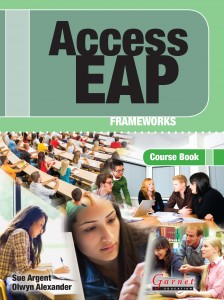
Sue Argent and Olwyn Alexander are the authors of Access EAP and EAP Essentials.